
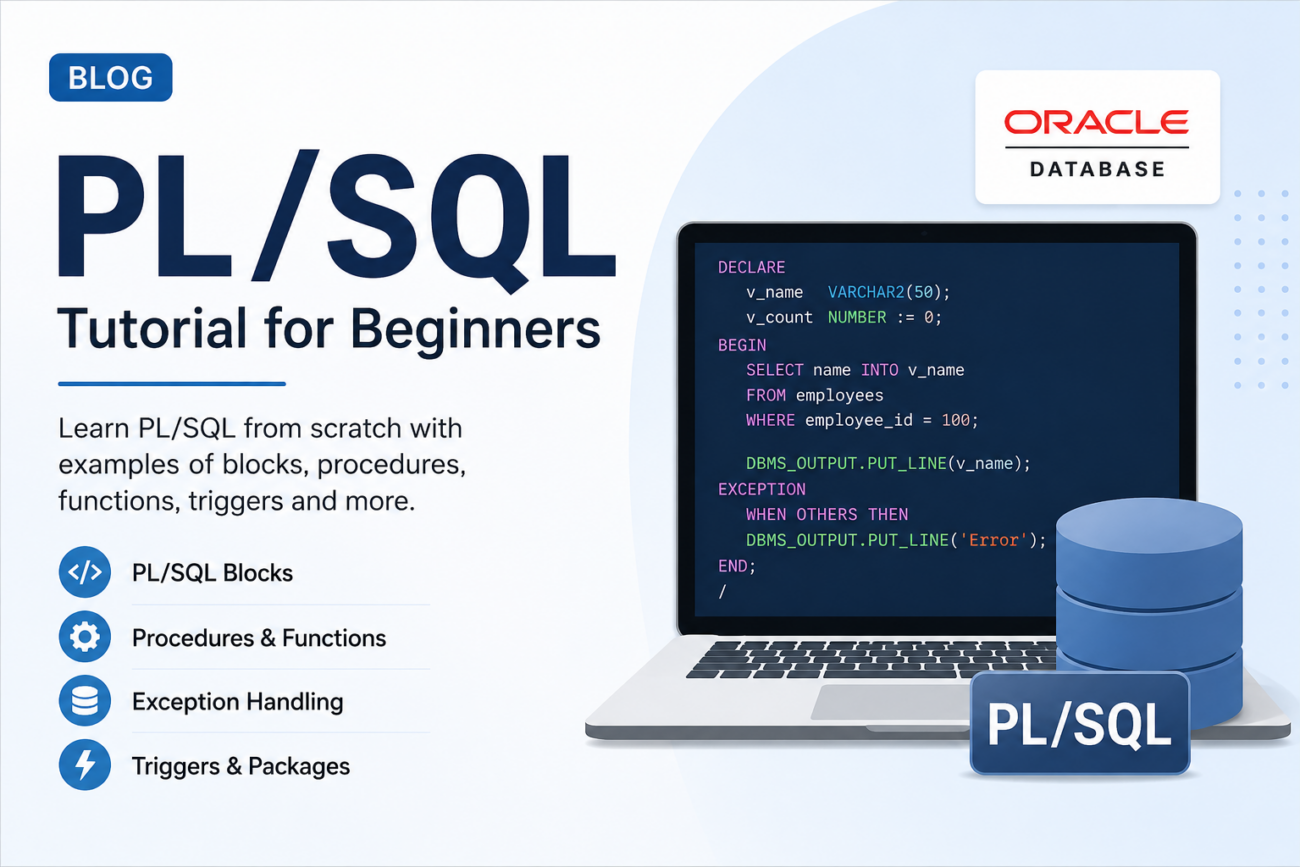
PL/SQL (Procedural Language/Structured Query Language) is Oracle’s procedural extension to SQL. It combines the power of SQL with programming features such as variables, loops, conditions, and exception handling, making database development more efficient and powerful.
What is PL/SQL?
PL/SQL allows developers to write complete programs that run inside the Oracle Database. Unlike SQL, which is mainly used for querying and manipulating data, PL/SQL enables you to create business logic directly within the database.
Key Features of PL/SQL
- Tight integration with SQL
- Block-structured language
- Error and exception handling
- Improved performance
- Code reusability through procedures and functions
- Enhanced security
Structure of a PL/SQL Block
A PL/SQL block consists of three sections:
DECLARE
   -- Variable declarations
BEGIN
   -- Executable statements
EXCEPTION
   -- Exception handling
END;
/
The DECLARE and EXCEPTION sections are optional, while the BEGIN...END section is mandatory.
Example: Display a Message
BEGIN
   DBMS_OUTPUT.PUT_LINE('Hello World from PL/SQL');
END;
/
This simple block prints a message to the output console.
Advantages of PL/SQL
1. Better Performance
PL/SQL executes multiple SQL statements in a single block, reducing network traffic between the application and database.
2. Error Handling
Built-in exception handling makes applications more reliable.
3. Modular Programming
Developers can create procedures, functions, packages, and triggers for reusable code.
4. Security
Business logic can be stored inside the database, reducing direct access to sensitive data.
Common PL/SQL Objects
- Procedures
- Functions
- Packages
- Triggers
- Cursors
These objects help organize and manage database applications effectively.
Conclusion
PL/SQL is an essential skill for Oracle database developers. By combining SQL capabilities with procedural programming features, it enables the creation of robust, scalable, and high-performance database applications. Whether you’re a beginner or an experienced developer, learning PL/SQL can significantly improve your database development skills.